Cognitive AV supports integrators and channel partners with overflow engineering packages, AV bid support, and room performance consulting for projects that need cleaner documentation and fewer surprises.
When engineering backlog builds up, documentation quality usually drops first. That leads to install confusion, avoidable RFIs, and commissioning delays. Cognitive AV provides structured design desk support to help teams move faster without lowering standards.
For AV integrators with engineering backlog, overloaded teams, or rooms waiting on documentation.
For low-voltage contractors, MSPs, and channel partners who need AV coverage in a bid.
For organizations with meeting rooms that sound poor, work inconsistently, or frustrate users.
Engineering backlog slows projects long before anyone says it out loud. Deadlines compress, documentation gets rushed, and install teams inherit the risk.
Cognitive AV acts as an external design desk for defined rooms and engineering packages. You provide the room requirements, standards, and constraints. We return structured documentation your installers and PMs can actually use.
Fast-turn package for one defined room or engineering scope.
Structured documentation package for rooms that need deeper engineering detail and stronger commissioning support.
Audit and correction of incomplete, inconsistent, or high-risk documentation before it becomes a field problem.
Reserved design desk availability for recurring partners who need faster response during backlog periods.
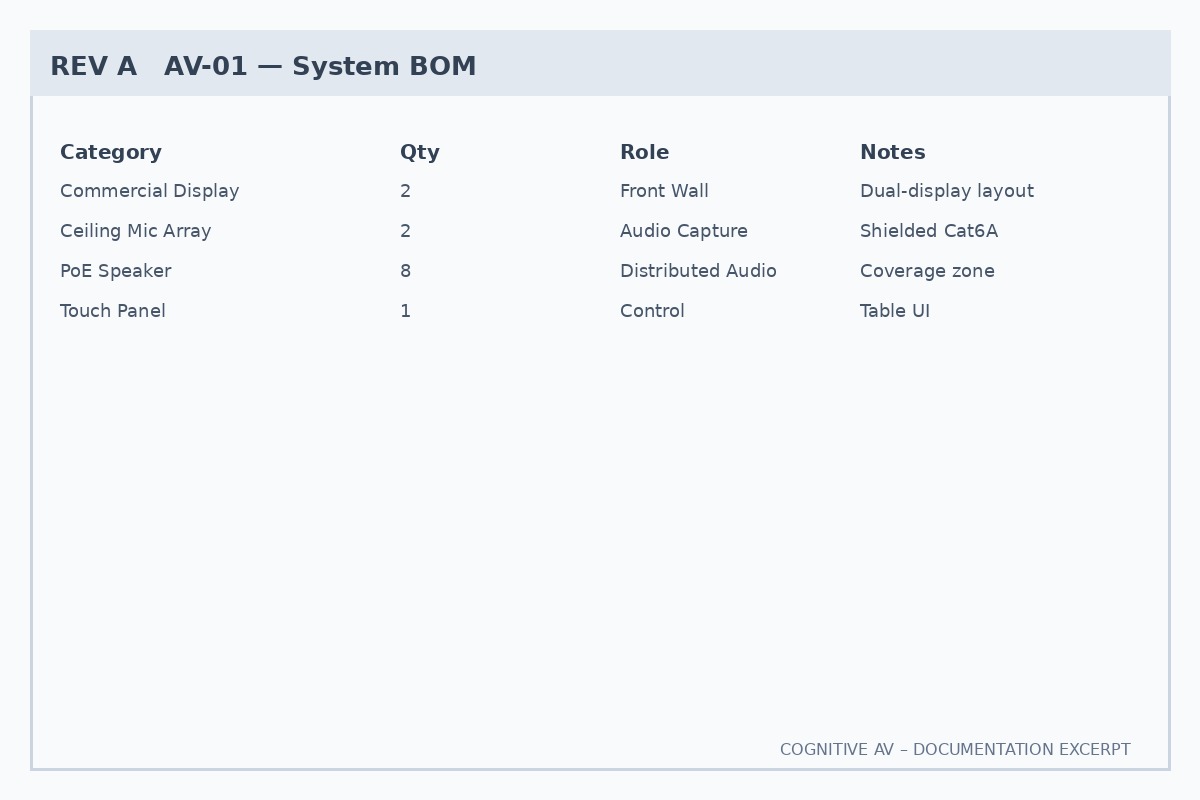
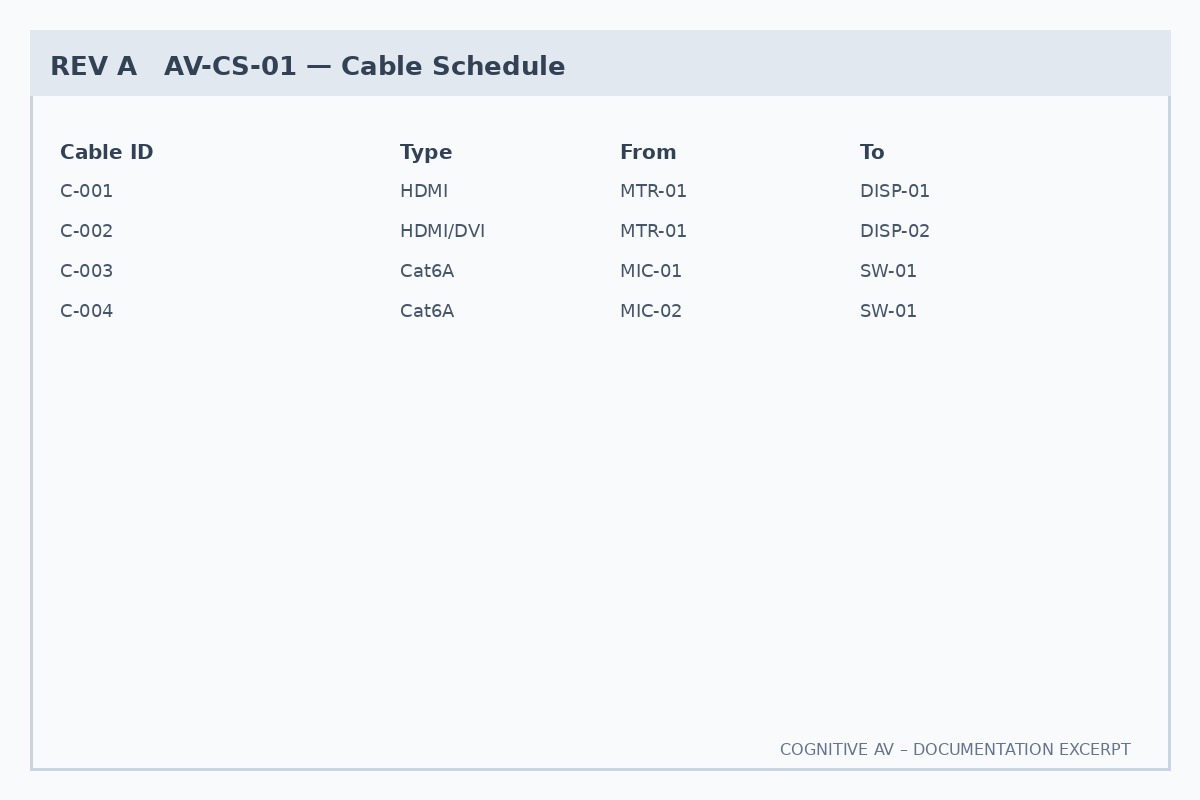
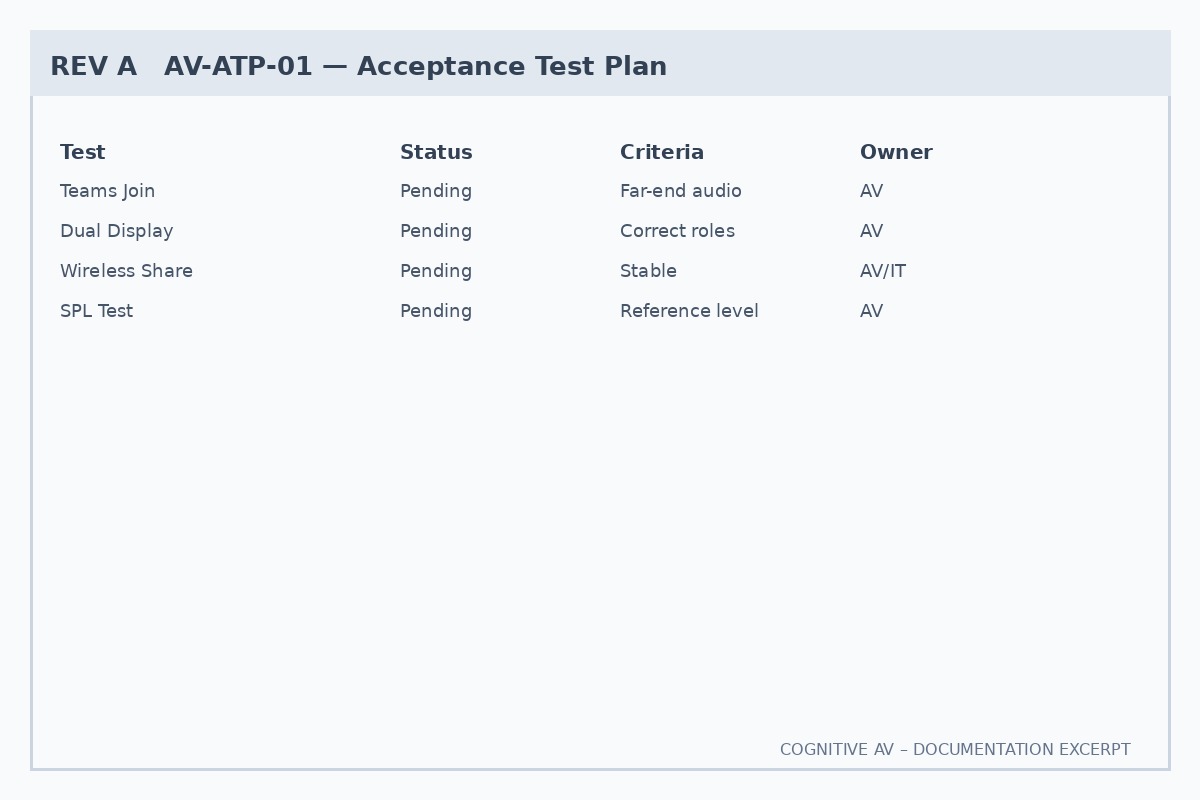
Technical buyers do not hire from adjectives. They hire from evidence. Below is the type of documentation Cognitive AV produces.
Packages are structured to be installer-ready, IT-aware, and easier to review, revise, and hand off.
Cognitive AV is led by Keith Gariepy , an AV and workplace technology operator focused on conference room documentation, design quality, and execution discipline.
Supporting enterprise AV documentation, delivery support, and workplace technology execution across complex project environments.
The practice is built around a simple standard: produce packages that installers can build from and PMs can manage without surprises. Cognitive AV is intentionally structured as a focused design desk rather than a generalist AV firm. That means tighter scope control, cleaner documentation, and less noise around the actual engineering work.
Low-voltage firms, MSPs, IT contractors, and adjacent trades are often asked to bid projects that include conference room AV, even when AV is not their core discipline.
Cognitive AV helps channel partners define AV scope more clearly so proposals are safer, pricing is more grounded, and post-award engineering is less chaotic.
Clarify what the room or package actually needs so the bid does not start with blind spots.
Provide a structured starting point for equipment, architecture, and scope assumptions.
Identify the dependencies, assumptions, and boundaries that should be stated before submission.
If the job is won, Cognitive AV can support the follow-on engineering documentation required for delivery.
Many conference rooms technically function but still fail the people using them. Audio feels distant, cameras feel impersonal, wireless presentation is unreliable, or the system is simply harder to use than it should be.
Cognitive AV audits underperforming rooms and provides a structured remediation plan so teams can fix the real problem instead of guessing.
Review room conditions, system behavior, documentation gaps, and likely causes of failure.
Prioritized action plan covering quick wins, deeper fixes, and coordination needs.
Focused review for rooms that were deployed but never fully tuned, validated, or documented.
The quality of an AV package depends on the quality of the inputs and the discipline of the process. Cognitive AV uses a structured workflow designed to reduce hidden risk before install.
Requirements, constraints, room conditions, and missing inputs are captured up front.
Assumptions, exclusions, dependencies, and open questions are defined before production begins.
The package is drafted using structured templates and reviewed for consistency across deliverables.
Redlines are handled in a controlled way so the package stays coherent as it evolves.
BOM, cable schedule, notes, and commissioning criteria are checked against each other before issue.
Strong AV documentation depends on strong inputs. Before production begins, Cognitive AV typically needs the following:
If key information is incomplete, Cognitive AV will flag assumptions, exclusions, dependencies, and open questions before production starts.
Whether you need overflow engineering support, AV scope help for a bid, or a room audit for an underperforming space, the best first step is a clearly bounded engagement with a visible output.
Start with a defined room, package, or cleanup scope.
Clarify scope, assumptions, and basis-of-design before submission.
Diagnose why the room is underperforming and define the fix path.